
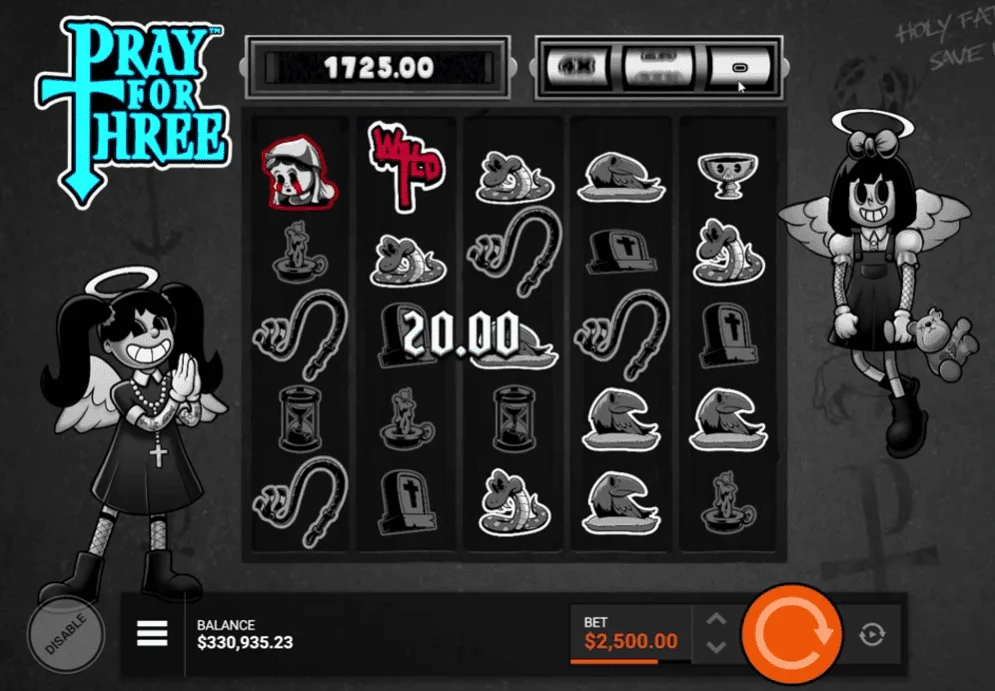
If you arrived here because you enjoy Pray for Six, then Pray for Three deserves a place on your radar. It is the slot most often mentioned in the same breath — same studio, same gothic universe, same multiplier-driven design. But the two games are not interchangeable, and choosing between them comes down to a few specific differences in maths and mechanics.
This article is a full breakdown of Pray for Three, followed by a straight head-to-head with Pray for Six so you can decide which one fits your style. We will keep the numbers honest and the hype to a minimum.
Pray for Three — key facts
- Provider
- Hacksaw Gaming
- Grid
- 5 × 5
- Ways to win
- 3,125
- RTP
- 96.33%
- Volatility
- High
- Max win
- 13,333×
- Hit rate
- ~27.7%
- Bet range
- €0.10–€100
What is Pray for Three?
Pray for Three is a 5×5 cascading slot from Hacksaw Gaming with 3,125 ways to win. It is a spiritual successor to the studio's earlier hit SixSixSix, and it shares that game's striking monochrome 1930s cartoon style — black and white with occasional splashes of cyan, soundtracked by an eerie cabaret-organ score.
The story follows two fallen sisters, Scary Mary and Morbid Magda, cast out of heaven and now scheming to rule the underworld. It is theatrically grim, but Hacksaw plays it with a wink rather than straight horror.
Mechanically, wins are formed by landing three or more matching symbols across the ways-to-win lines from the leftmost reel. Winning symbols are removed and new ones cascade down, so a single spin can chain several wins. The default RTP is 96.33%, with high volatility and a max win capped at 13,333× your stake. As with all Hacksaw titles, operators can select lower RTP builds — 94.25%, 92.27% and 88.35% — so checking the active figure matters.
The Wheel of Sin explained
Where Pray for Six has its Wailing Wheel, Pray for Three has the Wheel of Sin — a multiplier mini-feature sitting outside the main grid. It is the engine of the whole game, and understanding it is the key to understanding the slot.
The wheel is triggered by Prayer Hand symbols. When a Prayer Hand lands, it reveals a number from 1 to 3, which decides how many sections of the Wheel of Sin activate. A rarer Divine Prayer Hand guarantees that all three sections light up. When more than one section is active, the multiplier values combine left to right before being applied to your Total Win Bar.
The wheel can deliver both adding and multiplying multipliers, and at the top end the multiplying values reach as high as x33. Chain a few of those together inside a bonus round and the 13,333× ceiling stops looking theoretical.
The Wheel of Sin rewards patience: the best results come from earned Divine Prayer Hands, not from a single lucky spin.
The three bonus rounds
Like its siblings, Pray for Three is built around a three-tier bonus structure. Each round is triggered by FS Scatter symbols and begins with 10 free spins, with extra Scatters adding +2 or +4 spins.
- Wicked Ways — triggered by 3 FS Scatters. The entry-level round, playing much like the base game but with a higher rate of Prayer Hand symbols and extra Wilds.
- Living on a Prayer — triggered by 4 FS Scatters. Regular Prayer Hands are removed entirely; only Divine Prayer Hands appear, so every trigger activates all three Wheel sections.
- Flames of Fortune — triggered by 5 FS Scatters. The hidden epic round. A Divine Prayer Hand is guaranteed on every single spin, and it cannot be bought — it must trigger naturally.
For players who would rather skip the wait, Wicked Ways and Living on a Prayer can be purchased directly — roughly 100× and 225× your bet respectively. Flames of Fortune, as the marquee feature, has no price tag. Bonus buys are restricted in some jurisdictions, so the option may not appear at every casino.
Pray for Three gameplay video
If you would rather see the Wheel of Sin in motion before reading on, here is a full gameplay session from YouTube. Click to load the video.
Pray for Three vs Pray for Six
Both games are clearly cut from the same cloth, but the differences are real. Here is how they line up on the things that actually affect a session.
Grid and win system
Pray for Six uses a 6×5 grid with scatter-pays — you need 8+ matching symbols anywhere. Pray for Three uses a smaller 5×5 grid with a 3,125 ways-to-win system, paying from the leftmost reel. In practice Pray for Three feels a little more like a classic slot, while Pray for Six feels more modern.
Max win and volatility
Pray for Six aims higher: a 20,000× ceiling against 13,333× for Pray for Three. Pray for Six also sits at the more extreme end of the volatility scale. Pray for Three is still a high-variance game, but its slightly higher hit frequency (~27.7%) makes the base game marginally less punishing.
The wheels
The Wailing Wheel in Pray for Six and the Wheel of Sin in Pray for Three do similar jobs, but the Wheel of Sin's multi-section combine mechanic gives Pray for Three a slightly more strategic feel — you are always hoping for that Divine Prayer Hand to light all three sections.
Head-to-head
- Six — grid
- 6×5
- Three — grid
- 5×5
- Six — max win
- 20,000×
- Three — max win
- 13,333×
- Six — RTP
- 96.35%
- Three — RTP
- 96.33%
- Six — volatility
- Very High
- Three — volatility
- High
Verdict: which should you play?
There is no wrong answer here — both are strong Hacksaw releases. The choice comes down to appetite for risk.
Choose Pray for Six if you want the bigger ceiling and the most modern, extreme version of the formula. Choose Pray for Three if you like the slightly gentler base game, the ways-to-win structure and the strategic pull of the Wheel of Sin. Many players simply rotate between the two.
Whichever you pick, the same advice applies: these are high-volatility slots. Play the free demo first, confirm the casino is running the top RTP build, and treat any big win as a bonus, not an expectation.